
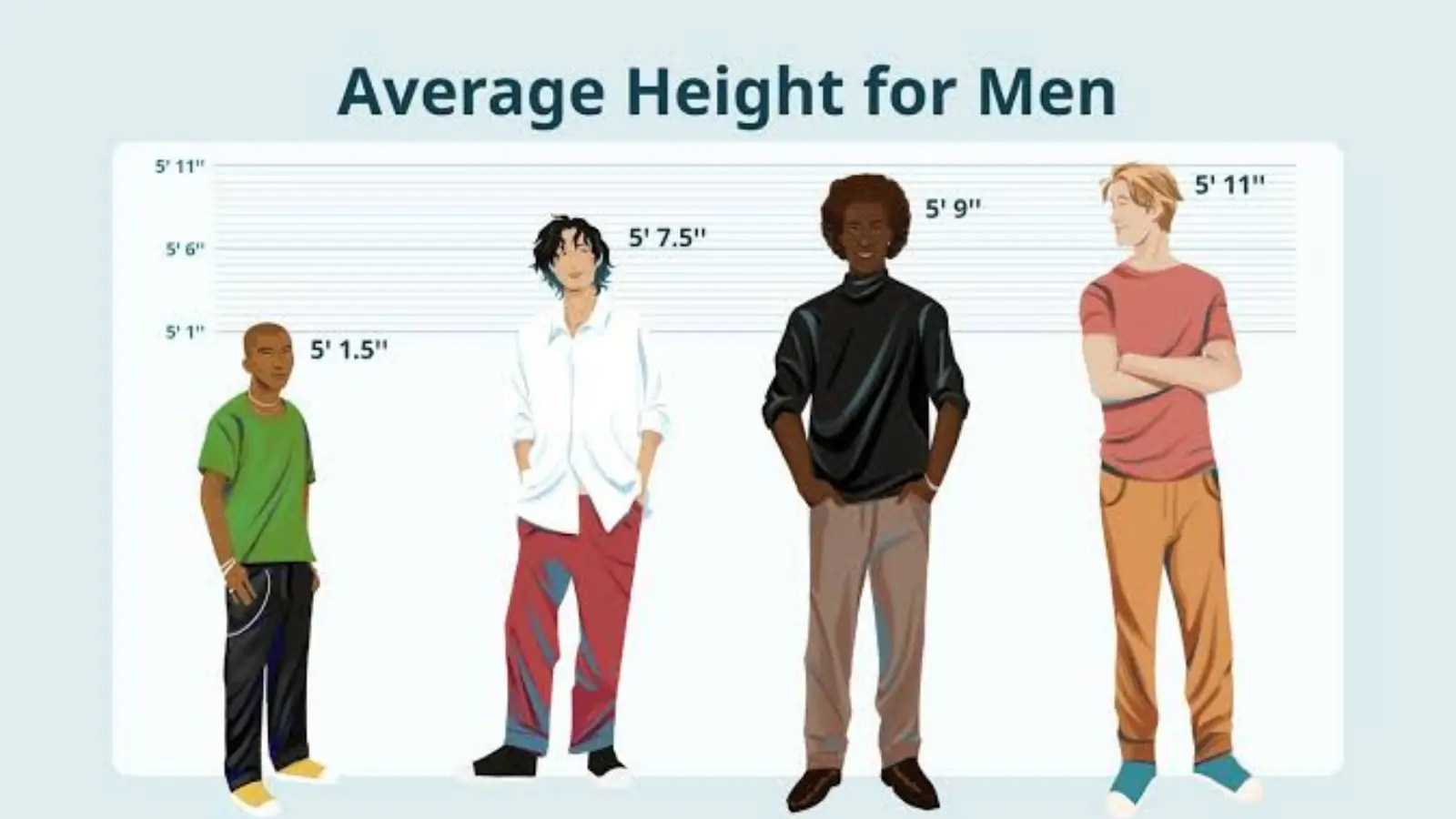
The average male height in America is approximately 5 feet 9 inches (175 cm) for adult men aged 20 and older. According to the U.S.
Centers for Disease Control and Prevention (CDC), the latest published measured data available in its body-measurement statistics report an average height of 68.9 inches, or approximately 5 feet 8.9 inches.
These figures are based on national health examination data collected in 2021–2023.CDC
Understanding the average male height in America helps people compare their own height with national statistics and learn how age, genetics, nutrition, and childhood development influence adult stature.
It also explains why people are curious about the heights of celebrities such as Tom Cruise, Cristiano Ronaldo, Lionel Messi, and Barron Trump.
Although these public figures attract attention because of their appearance, their heights are individual measurements rather than reliable indicators of the national average.
In this guide, we explore current U.S. statistics, height differences by age, comparisons with famous personalities, and the science behind human growth.
What Is the Average Male Height in America in 2026?
As of 2026, the most recent figures published on the CDC’s body-measurement statistics page put the average height of American adult men at 68.9 inches.
Here are the essential measurements:
- Feet and inches: Approximately 5 feet 8.9 inches, commonly rounded to 5 feet 9 inches.
- Centimeters: Approximately 175 cm.
- Population: U.S. men aged 20 and older.
- Data source: CDC National Center for Health Statistics, using measured data from August 2021 through August 2023.
The distinction between a rounded figure and an exact measurement matters. Saying that the average American man is 5 feet 9 inches is a useful everyday approximation, not a claim that every man measures exactly that height.
The CDC statistics are based on physical measurements rather than simply asking participants how tall they believe they are. This makes them a valuable reference for understanding the country’s adult population.
It is also important to remember that 2026 is the year in which readers are looking up the statistic, not necessarily the year in which every participant was measured. National surveys take time to collect, analyze, and publish.
Average Male Height in America in Feet, Inches, and Centimeters
Height measurements can be confusing when websites use different units or round numbers differently. The following table converts the commonly reported U.S. average into several useful formats.
| Measurement format | Average adult male height |
| Feet and inches | About 5 ft 9 in |
| Inches | 68.9 inches |
| Centimeters | About 175 cm |
| Meters | About 1.75 m |
These values describe essentially the same height, with minor differences caused by rounding.
For reference, one inch equals 2.54 centimeters, and one foot equals 12 inches. Therefore, 68.9 inches converts to approximately 175.0 centimeters.
How to Convert Height From Inches to Centimeters
To convert inches into centimeters, multiply the measurement by 2.54.
For example:
68.9 × 2.54 = 175.006 centimeters.
The result is approximately 175 cm.
To convert centimeters into feet and inches, divide the measurement by 2.54 to find the number of inches. Then divide those inches by 12 to determine the feet, with any remaining inches added afterward.
These simple conversions are useful when comparing U.S. height statistics with international studies, sports profiles, and celebrity biographies.
How Does the Average Male Height in America Vary by Age?
Not every age group has the same average height. Younger and middle-aged adult men generally measure slightly taller on average than the oldest age groups. This pattern reflects both differences between generations and changes that can occur during aging.
CDC National Center for Health Statistics data from 2015–2018 provide a useful age-based comparison.
| Age group | Mean height in centimeters | Approximate height |
| 20–29 | 175.8 cm | 5 ft 9.2 in |
| 30–39 | 176.3 cm | 5 ft 9.4 in |
| 40–49 | 176.3 cm | 5 ft 9.4 in |
| 50–59 | 175.4 cm | 5 ft 9.1 in |
| 60–69 | 174.4 cm | 5 ft 8.7 in |
| 70–79 | 173.0 cm | 5 ft 8.1 in |
| 80 and older | 170.4 cm | 5 ft 7.1 in |
Source: CDC/NCHS, Anthropometric Reference Data for Children and Adults: United States, 2015–2018. Read the report.
These figures come from an earlier survey period than the CDC’s latest overall estimate. They should not be presented as the latest 2026 measurements for each age group.
Why Do Older Men Tend to Be Shorter?
There are two main reasons for the observed difference.
First, older adults can gradually lose height as they age. Changes in the spinal discs, posture, and bone health can contribute to a reduction in measured stature.
Second, different generations may have experienced different childhood living conditions, nutrition, healthcare access, and disease burdens. Consequently, the average height of today’s younger adults may differ from that of older adults.
These age-group statistics describe population averages. They cannot tell us precisely how much height a particular individual will lose over their lifetime.
Average Male Height in America Compared With Other Countries
The average male height in America is useful as a national benchmark, but it does not mean American men are the tallest in the world.
Adult height varies among countries and populations because of a combination of genetics, childhood nutrition, healthcare, socioeconomic conditions, and environmental influences.
International comparisons also require careful attention to methodology. One study might measure adults aged 18 and older, while another includes only people aged 20–49. Some figures are based on direct measurements, whereas others rely on self-reported information.
For a reliable comparison, readers should look for statistics that use similar age groups, measurement methods, and survey periods.
Why Do International Height Rankings Differ?
Several factors can influence the rankings:
- Genetics: Population-level genetic differences contribute to variation in average stature.
- Childhood nutrition: Sufficient calories, protein, and micronutrients support normal development.
- Healthcare: Preventing and treating childhood illnesses can help children reach their growth potential.
- Living conditions: Poverty, food insecurity, and repeated infections can affect growth during development.
- Data collection: Different sampling methods and age ranges can produce different reported averages.
A country’s position in a height ranking does not determine the height of any particular citizen. Individuals within every country vary considerably, and national averages should not be treated as rigid expectations.
How Tall Is the Average American Man Compared With Celebrities?
Celebrity height comparisons are popular because familiar public figures give readers an easy visual reference. However, reported celebrity heights may be rounded, outdated, or repeated across websites without independent verification.
The following examples use commonly reported profile figures as approximate comparisons rather than claiming that each height has been independently measured.
| Celebrity or athlete | Commonly reported height | Comparison with a 5 ft 9 in average |
| Tom Cruise | Around 5 ft 7 in (170 cm) | About 2 inches shorter |
| Lionel Messi | Around 5 ft 7 in (170 cm) | About 2 inches shorter |
| Cristiano Ronaldo | Around 6 ft 2 in (187 cm) | About 5 inches taller |
| Taylor Swift | Around 5 ft 11 in (180 cm) | About 2 inches taller |
These figures are approximate public-profile measurements, not official U.S. population statistics. Taylor Swift is included as a familiar comparison even though she is not male; her height should not be used to estimate the average height of American men.
Barron Trump Height and the Average American Man
Barron Trump frequently attracts online interest because of his height and his appearances alongside his family. However, estimates of his height vary among online publications, and a definitive current measurement should not be assumed without a reliable source.
His example illustrates a broader point: photographs can make people appear taller or shorter depending on footwear, camera angles, posture, and the height of those standing nearby.
A celebrity’s stature can be interesting, but the CDC’s measured population data are a more dependable source for understanding the average American man’s height.
Does Height Affect How Tall Someone Looks?
Yes. A person’s apparent height can be influenced by more than their actual standing measurement.
- Shoes and boots can add height.
- Camera angles can exaggerate differences.
- Posture can make someone appear taller or shorter.
- Clothing proportions can influence visual perception.
- Standing beside a much taller or shorter person changes the impression of relative height.
For these reasons, photographs are not a reliable way to determine someone’s exact height.
Why Are Some American Men Taller or Shorter Than Average?
The average male height in America represents a midpoint in a broad range of individual heights. Some adult men are considerably taller than 5 feet 9 inches, while others are considerably shorter.
Neither difference automatically indicates a health problem. Normal human height varies naturally, and the average is a statistical summary rather than a minimum or maximum requirement.
1. Genetics and Family Height
Genetics is one of the strongest influences on adult height. Children inherit genetic variants from both parents, and these influence growth patterns, skeletal development, and the timing of puberty.
A child with tall parents may be more likely to become tall, while a child with shorter parents may be more likely to be shorter. Nevertheless, genetics does not predict height with perfect accuracy.
Siblings can have different adult heights even when they grow up in the same household because they inherit different combinations of genetic variants and experience individual differences in development.
2. Nutrition During Childhood
Adequate nutrition supports bone development, muscle growth, and the many biological processes that contribute to normal stature.
Important nutritional components include:
- Protein for the body’s growth and tissue maintenance.
- Calcium and vitamin D for bone health.
- Zinc and other essential micronutrients.
- Sufficient overall energy to support normal development.
Severe or prolonged nutritional deficiencies during childhood can interfere with growth. However, taking extra supplements does not automatically make a healthy adult taller.
3. Sleep and Growth Hormones
Sleep is important for normal development, particularly during childhood and adolescence. Growth hormone is released in pulses, including during sleep, and plays a role in the body’s growth processes.
Children and teenagers benefit from age-appropriate sleep and healthy routines. Still, sleeping more than necessary is not a guaranteed way to increase adult height, and sleep cannot overcome every genetic or medical limitation.
4. Physical Activity and General Health
Regular physical activity supports strong bones, muscles, coordination, and overall health. Activities such as walking, running, swimming, and age-appropriate resistance exercises can be valuable parts of a healthy lifestyle.
Stretching and hanging exercises may temporarily affect posture or spinal loading, but they do not permanently lengthen the bones of a fully grown adult.
A balanced approach to exercise supports health without promising unrealistic changes in stature.
5. Medical Conditions and Hormonal Factors
Some medical conditions can affect growth, especially if they interfere with hormones, bone development, or nutrient absorption.
For example, certain growth hormone disorders, thyroid conditions, and chronic illnesses can affect a child’s growth pattern. Early medical evaluation may help identify treatable causes when a child’s growth differs substantially from the expected pattern.
Most variation in adult height, however, should not be interpreted as evidence of a disease. A healthcare professional can assess concerns using growth charts, family history, examination findings, and relevant tests.
How Does Height Change From Childhood to Adulthood?
A person’s height develops through several stages. Understanding these stages explains why a child’s height cannot be compared directly with the average height of an adult American man.
Infancy and Early Childhood
Growth is rapid during infancy and early childhood. Children gain height as their bones lengthen and their bodies develop.
Growth rates vary, so healthcare professionals often assess a child’s measurements over time rather than drawing conclusions from one measurement.
Middle Childhood
Growth continues during the school years, generally at a steadier pace than during infancy. Genetics, nutrition, sleep, and overall health all contribute to the pattern.
Consistent tracking helps distinguish a child’s individual growth trajectory from normal short-term variation.
Puberty and the Teenage Years
Puberty brings substantial changes in height for many adolescents. The timing and size of the growth spurt vary from person to person.
Some teenagers grow earlier than their peers, while others continue growing later. Comparing classmates at one point in adolescence can therefore be misleading.
Late Adolescence and Early Adulthood
Most males approach their adult height by the end of puberty, once the growth plates in their bones close. The timing varies, and some individuals continue growing into their late teens or, less commonly, the early twenties.
After the growth plates have closed, ordinary lifestyle changes cannot restart the normal process of bone lengthening.
Middle Age and Older Adulthood
Adult height is relatively stable for many years, but measured stature can gradually decrease with age. Changes to the spine, posture, and bone health can contribute to this decline.
The differences between older and younger groups in population surveys also reflect generational influences, so they should not be interpreted solely as the amount of height individuals lose as they age.
Is 5 Feet 9 Inches Tall, Short, or Average for an American Man?
A height of approximately 5 feet 9 inches is very close to the national average for adult American men.
Here is a practical way to interpret common height measurements:
| Height | General comparison with the average |
| 5 ft 5 in (165 cm) | Below average |
| 5 ft 7 in (170 cm) | Below average |
| 5 ft 9 in (175 cm) | Approximately average |
| 5 ft 11 in (180 cm) | Above average |
| 6 ft 0 in (183 cm) | Clearly above average |
| 6 ft 2 in (188 cm) | Considerably above average |
These labels are informal comparisons, not medical categories. They also do not represent exact percentiles.
For a more precise statistical interpretation, researchers examine the distribution of heights, including the median and percentiles. A person who is taller than the mean is not necessarily taller than most people by a large margin.
Mean Height Versus Median Height
The mean is calculated by adding all measurements and dividing by the number of observations. The median is the middle measurement when everyone is ordered from shortest to tallest.
The CDC’s 2015–2018 data reported a mean of 175.3 cm and a median of 175.4 cm for adult men aged 20 and older. These figures are nearly identical, showing that the average and midpoint were very similar in that survey.
Both measurements help describe the population, but neither tells us exactly where an individual falls without additional distribution data.
Has the Average Male Height in America Increased Over Time?
Average height can change across generations, but it does not necessarily rise continuously.
Historical U.S. data demonstrate that adult male height has fluctuated. In the CDC’s earlier series, the age-adjusted mean height for adult men rose from 175.6 cm in 1999–2000 to 176.4 cm in 2003–2004, before declining to 175.4 cm in 2015–2016. These figures come from a historical series and should not be confused with the newer overall estimate of 68.9 inches.
Several factors can influence long-term population patterns, including childhood living conditions, nutrition, disease exposure, and the characteristics of the population being measured.
Why Does Historical Data Matter?
Historical measurements provide context for today’s statistics. They help researchers assess whether population health and development have changed across generations.
However, a small difference between two survey averages does not automatically establish a meaningful biological trend. Researchers must consider statistical uncertainty, differences in sampling, age adjustment, and measurement methods.
When reading a height statistic online, always check the survey years. A number described as the average in 2026 may actually come from data collected several years earlier.
Interesting Facts About the Average Male Height in America
Height statistics become more useful when readers understand what the numbers do—and do not—mean.
- The average is not a target. There is no single height that every adult man should reach.
- Most people differ from the average to some extent. A population includes a range of heights, not one standard measurement.
- Measured data are valuable. Direct measurements reduce errors caused by people rounding up their self-reported height.
- Age matters. Older and younger adult groups can have different averages.
- Generational differences matter. Childhood conditions can influence height patterns across birth cohorts.
- Genetics plays a major role. Family height offers useful context, but it cannot predict an individual’s final height perfectly.
- Nutrition supports normal growth. Adequate nutrition is particularly important during childhood and adolescence.
- Posture affects appearance. Standing straight can change apparent height without changing bone length.
- Celebrity profiles are not national surveys. A famous person’s height says little about the average of millions of Americans.
- Small measurement differences can be misleading. Rounding inches and centimeters can create apparent discrepancies between websites.
These facts highlight why the average male height in America should be understood as a population statistic, rather than a personal benchmark for attractiveness, fitness, or success.
Frequently Asked Questions About Average Male Height in America
1. What is the average male height in America in 2026?
The latest CDC body-measurement statistics report an average height of 68.9 inches for adult American men aged 20 and older, based on data collected in August 2021–August 2023. This is approximately 5 feet 9 inches, or 175 cm.
2. What is the average American man’s height in feet and inches?
The average is commonly rounded to 5 feet 9 inches. The reported figure of 68.9 inches is just under 5 feet 9 inches, so the rounded description is appropriate for everyday use.
3. What is the average male height in America in centimeters?
The latest published overall estimate is approximately 175 cm. The precise conversion of 68.9 inches is about 175.0 cm.
4. Is 5 feet 8 inches short for an American man?
Five feet 8 inches is slightly below the national average of approximately 5 feet 9 inches. It is a normal adult height, and being below the average does not automatically indicate a medical concern.
5. Is 6 feet tall above average in America?
Yes. Six feet is approximately 183 cm, which is around 8 cm taller than the reported average of 175 cm for adult American men.
6. Has the average male height in America increased in recent years?
Not consistently. Historical CDC data show fluctuations over time rather than a continuous increase. Meaningful comparisons require consistent survey methods, appropriate age groups, and attention to the years when measurements were collected.
7. Why are some men taller than the national average?
Genetics is a major influence, while childhood nutrition, overall health, hormones, and environmental conditions also contribute. Differences in adult height are normal, and height alone cannot establish whether someone is healthy.
8. Can adults increase their height naturally?
Once growth plates have closed, adults generally cannot increase the length of their bones through exercise, stretching, supplements, or sleep. Improving posture may affect apparent height, while appropriate nutrition and exercise support general health.
9. Is the average male height in America the same for every age group?
No. CDC survey data show differences between adult age groups. These differences may reflect both age-related height loss and variations in the childhood conditions of different generations.
10. Are celebrity heights useful for comparison?
Celebrity heights can provide familiar reference points, but published figures are not always independently verified. Official population measurements are more reliable for determining the average height of American men.
Conclusion
The average male height in America is approximately 5 feet 9 inches (175 cm), based on the latest overall measured estimate published by the CDC.
This figure provides a useful reference for understanding adult height, but it does not define an ideal or required stature.
Individual height depends heavily on genetics and is also influenced by childhood nutrition, health, and development. Age and generational differences help explain why average measurements vary across studies.
Whether readers are comparing themselves with celebrities, exploring international statistics, or simply curious about their own height, reliable measured data offer a clearer picture than online guesses or photographs.
Ultimately, height is only one aspect of human physical variation.

Emma Collins writes creative pick up lines for readers looking to add humor and confidence to their chats. Her content focuses on clever openers and fun conversation ideas.